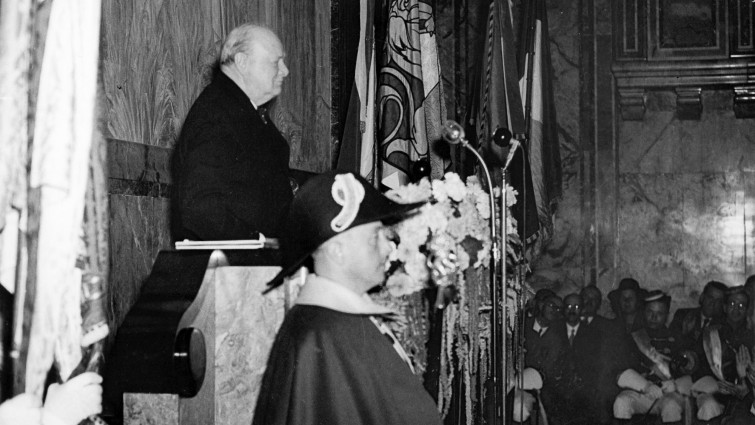
On September 19, 1946, Winston Churchill, former prime minister of the United Kingdom, held a speech in Zurich, in which he gave his vision of a united Europe. Even though Churchill was quite enthusiastic (“Let Europe arise!”), he did not envision a British membership in the future “United States of Europe”. When Churchill was reappointed prime minister in 1951, he was not willing to join the European community of the Schuman Plan, because he was still thinking of Britain as an independent great power.
Premières européennes
Britain and Europe since 1945
March 5, 2026
➣ Watch the BBC documentary Europe, them and us (2016) Part One, “An Island apart” (The second part is about the post-1991 era).
➣ How can we explain that Britain joined the European community belatedly, in 1973, then left the EU in 2020 ?
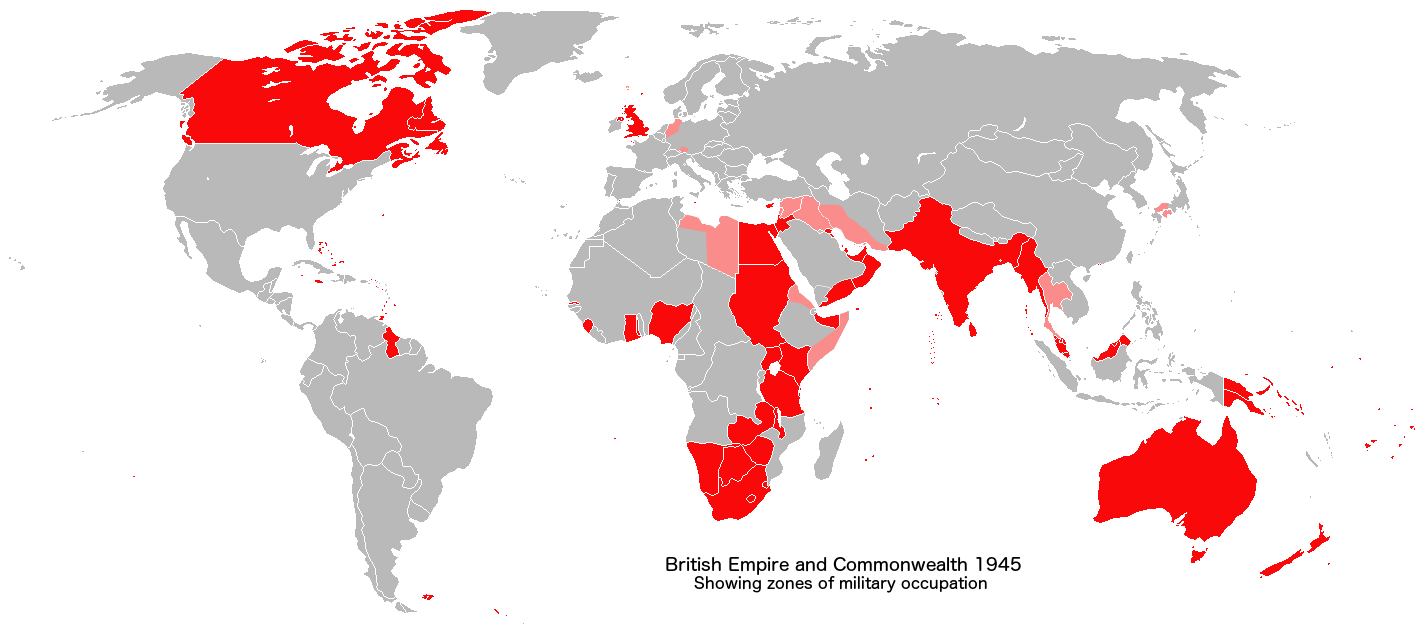
The British Empire in 1945. The territories coloured in pink (military occupation) were not part of the Empire. At the end of WW2, Britain was still a world empire, but that empire, weakened by two world wars, was crumbling. Nevertheless, the British would still consider themselves a global power. Map : © Wikipedia.
1 | Britain’s support to European unity (1946-1950)
❑ Back in 1945, Britain was still the British Empire, a world empire.
But, even though Britain had won the war, the country was ruined, and could no longer compete with the true winners of WW2, its allies : the USA on the one hand, on the other hand the USSR (or Soviet Union).
❑ In 1945, the most fervent supporter of a united Europe was Winston Churchill, the famous wartime leader. He had just been defeated in the general election that followed the end of the war. He feared the rise of the Soviet Union, and urged the Europeans to unite.
March 12, 2026
➪ See subject №1 : Churchill and Europe, Churchill’s speech in Zurich (1946) and an extract from a speech given in 1953 : “If Britain must choose between Europe and the open sea, she must always choose the open sea.”
March 19, 2026
➪ Subject №2 : Churchill at the Congress of Europe in The Hague (1948).
March 26, 2026
2 | Britain outside Europe
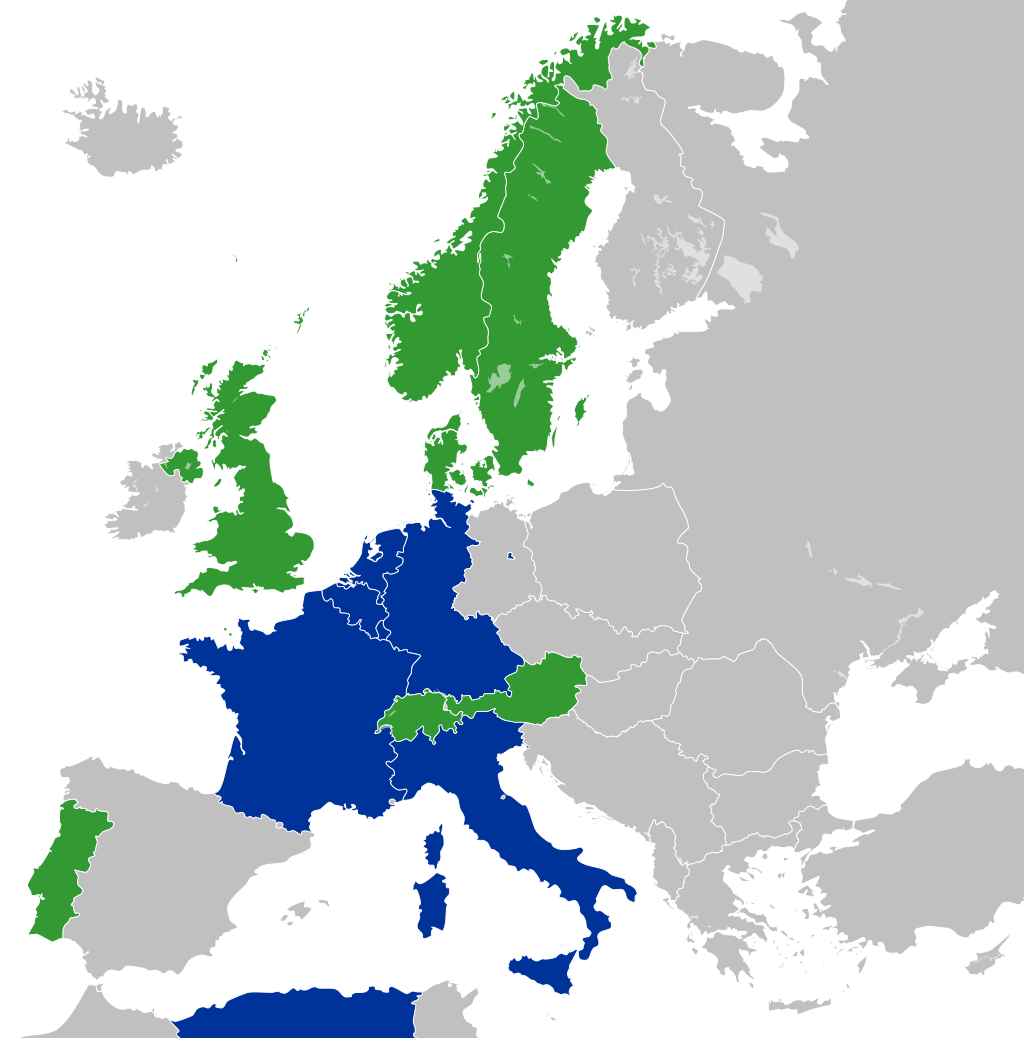
The two competing European free trade zones in 1961 : the European Economic Community (EEC, blue) established by the treaty of Rome in 1957, and the European Free Trade Association (EFTA, green) created in 1960. As it soon appeared, the EFTA (or “outer Seven”) was much less efficient than the EEC (“the inner Six”) which was also a political project, and included three strong economic powers (France, Italy and Western Germany). Besides, the Six benefitted from common borders while the Seven were scattered at the periphery of Western Europe. The limitations of the EFTA left Britain with only one option : to become a member of the EEC. Note that French Algeria was part of the EEC. Algeria became independent in 1962.
❑ On 9 May 1950, Robert Schuman, the French Foreign minister, announced a plan to build a European Coal and Steel Community (ECSC), including six Western European countries : Belgium, The Netherlands, Luxemburg, Italy, the Federal Republic of Germany and France. It came into effect in 1951. That is why May 9th became Europe’s day. The Schuman Plan had been drafted by Jean Monnet.
❑ Two years later (1952), a European Defence Community was planned, because the USA insisted in the context of the Korean war. But it did not materialise. In the end (1954), the French parliament rejected the EDC. The European army never existed.
❑ On 25 April 1957, the European Economic Community (EEC) was created between the Six of the ECSC. It was a common market, with the prospect of further integration (a political aim). Britain did not join the EEC. The British tried to create a competing community : the European Free Trade Association (EFTA) with seven members. Soon, the EEC proved to be much more promising, much more powerful. Even though they were reluctant to join the EEC, the British decided to make a bid as early as 1962. But they were met by De Gaulle’s fierce resistance : his answer, in 1963, was a “non”.
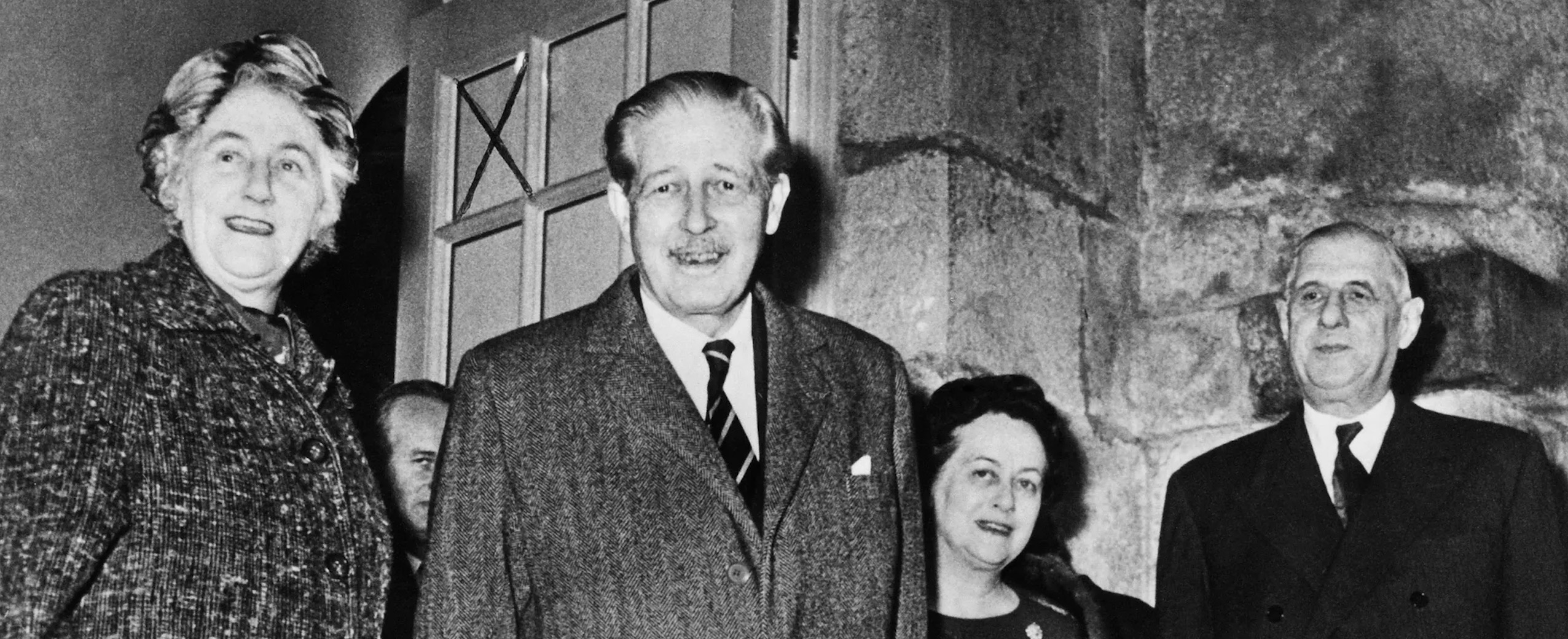
In January 1963, Charles de Gaulle, the French president, rejected the British bid for an EEC membership, thus ruining Prime minister's Macmillan's efforts to join the Common Market.
- De Gaulle, indeed, saw the UK as a Trojan horse, working to advance America’s influence within the EEC.
- He did not want to get the agricultural products of the Commonwealth in the common market.
- Last but not least, he felt offended by the Anglo-American agreement on nuclear weapons (signed in 1962), through which the US would supply the UK with Polaris missiles. For De Gaulle, a national deterrent was a matter of sovereignty. And he wanted to rule the small Europe of the Six.
Available subjects (to be prepared for April 2)
Recommended
➪ Subject № 3: The temptation of Europe : text by Edward Heath on West Germany and the Schuman Plan and German cartoon on Britain's reaction to the Schuman Plan.
➪ Subject № 4: Britain and Europe : at Sixes and Sevens : satirical cartoon comparing the EEC with the EFTA, another cartoon about De Gaulle opposing the British bid for an EEC-membership.
At your own risk...
➪ Subject № 5: Britain's European dilemma in the 1960s : texts about the Conservative Prime minister Harold Macmillan and another text by the leader of the Labour party Hugh Gaitskell, both voicing reservations about joining the Common market.
April 2, 2026
3 | Britain in Europe
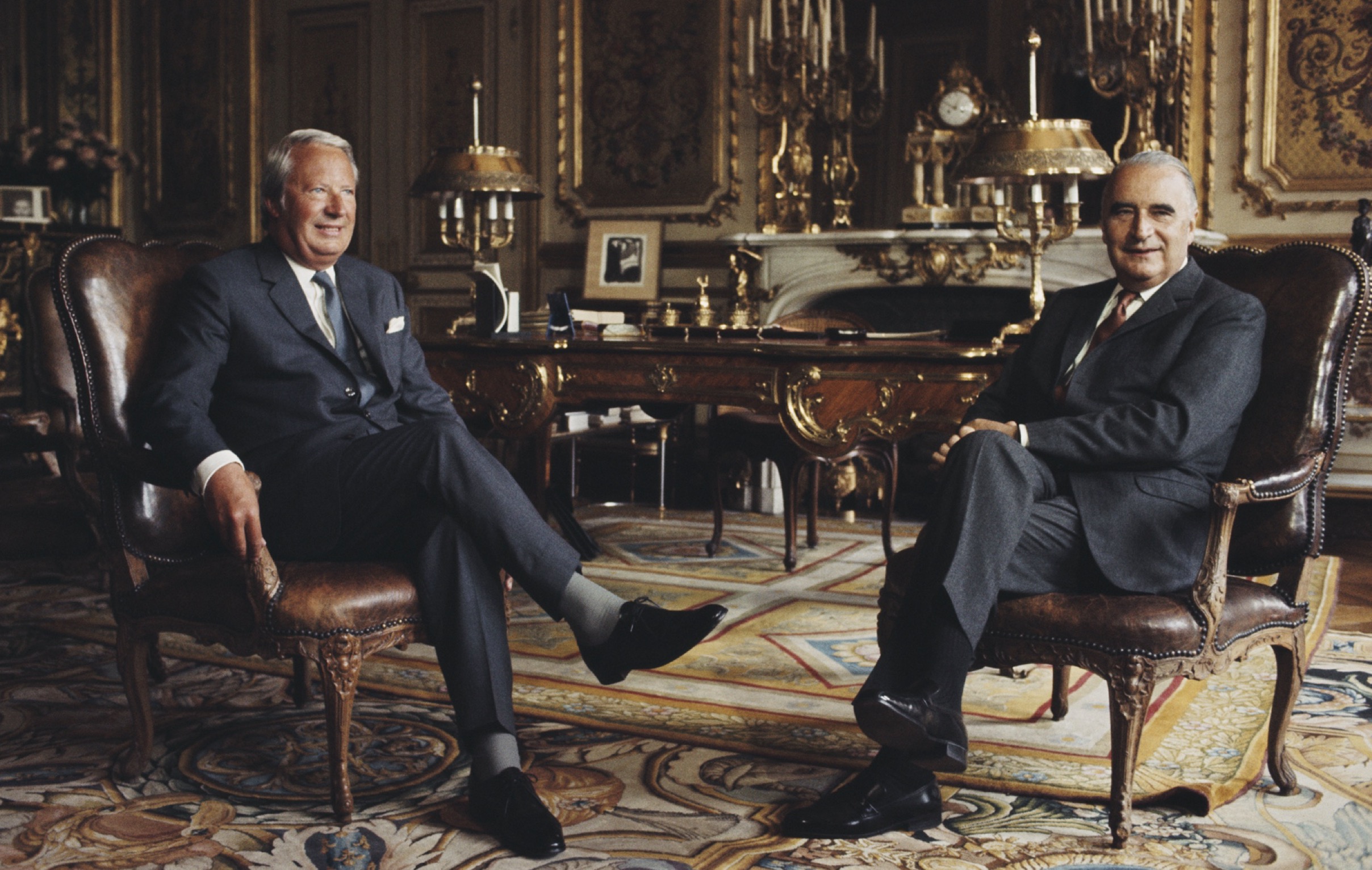
In 1972 however, Georges Pompidou, De Gaulle's successor and former Prime minister, negotiated with Prime minister Edward Heath Britain's entry into the EEC. Heath had previously been the chief negotiator for the First British bid back in 1962. While Britain desperately needed access to the Common Market, Pompidou, confronted with a stronger Federal Republic of Germany and the risk of “condominium” of the USA and the USSR at the world scale, was seeking a new balance in Europe. Britain, Ireland and Denmark entered the EEC in 1973.
New subjects
➪ Subject № 6: The 1980s or the Thatcher era : photo of Thatcher campaigning for Europe in 1975, excerpt from her Bruges speech (1988).
➪ Subject № 7: Thatcher and Europe. A cartoon about Britain compared with the Trojan Horse, an excerpt from the Bruges speech by Margaret Thatcher.
➣ In 1973, after two failed bids under De Gaulle (1963 and 1967), Britain eventually entered the EEC. Why ?
❑ New statesmen had taken over : in Britain, Edward Heath, who had negotiated the two failed bids. He was a europhile. In France, Georges Pompidou (1969-74 president, but Prime minister from 1962 to 1968). They were both experienced.
❑ the circumstances too had changed. Pompidou and Heath feared that Moscow and Washington might reach an agreement at the expense of Europe. Besides, the Federal Republic of Germany had grown stronger, and Chancellor Willy Brandt was carrying out a new foreign policy towards the East (Ostpolitik), with the prospect of a future German reunification.
Vocabulary
Sluggish : lacking energy or alertness, slow to respond or make progress.
To keep pace with : to move, develop, or progress at the same speed as...
❑ The consequences were not those expected : Heath was defeated in 1974. As early as 1975, a referendum on leaving the EEC was set up in Britain. The yes won. The sluggish British economy could not keep pace with the continental countries of the EEC.
❑ In 1979, the Conservative Margaret Thatcher won the general election. She was determined to rebuild a strong British economy by “rolling back the borders of the state”. She was influenced by neoliberalism, just like her American friend Ronald Reagan. She was hostile to European integration. Her only claim in the EEC was “to get her money back”.
April 9, 2026
❑ This was the time when Europeans tried to increase integration. Jacques Delors was the chairman of the European Commission from 1984 to 1994. In Britain, the tabloid The Sun started to take on Delors in a most offensive style. Thatcher wanted to stay in the EEC, but she did not wish it to become more than a free trade zone.
❑ Her successor John Major (1990-1997) led the UK into the European Union, but Britain kept the Pound. The European Union was agreed upon with the Treaty of Maastricht (1991) and created the common currency (the euro) and a European citizenship. Those who opposed expanding the powers of the EU were called eurosceptics (euroscepticism). The word appeared just after Maastricht was signed. Among the eurosceptics was a young English publicist named Boris Johnson. Nevertheless, the EU came into effect in 1993.
May 7, 2026
❑ Britain signed the Maastricht treaty, but did not join the eurozone. Instead of the common currency, they kept the Pound (£). By the same token, they did not join the Schengen agreement about free circulation in the EU in 1996. The UK had not signed the same treaty as other members. There was a British exception in Europe.
❑ The EU was enlarged in 2004 : from 15 to 25, then 28 members. 8 of the new members in 2004 were countries from Eastern Europe.
- The UK, like France, now was on the western margins of the UE, while Germany (the reunified Germany) was at the centre. The British started to resent their decline.
- Even though the UK did not join Schengen, there were many immigrants from eastern Europe. This led to widespread xenophobia. Euroscepticism was increasing.
The 2010 election
- Since 2007, the PM was Gordon Brown (who succeeded Tony Blair 1997-2007).
- Brown was weakened by the economic downturn.
- among the three main candidates, David Cameron, the leader of the conservatives, was ambiguous about Europe: he said that he wanted to be in Europe, but he was lukewarm about the European institutions. In fact, he knew that many of his voters were eurosceptics. As he wanted to get their votes, he was making concessions to euroscepticism.
- Nick Clegg, for the Liberal-Democrats, and Gordon Brown for the Labour, were clearly pro-European. But a new party, UKIP was campaigning hard to win the votes of the eurosceptics. See the transcript of the Bristol debate.
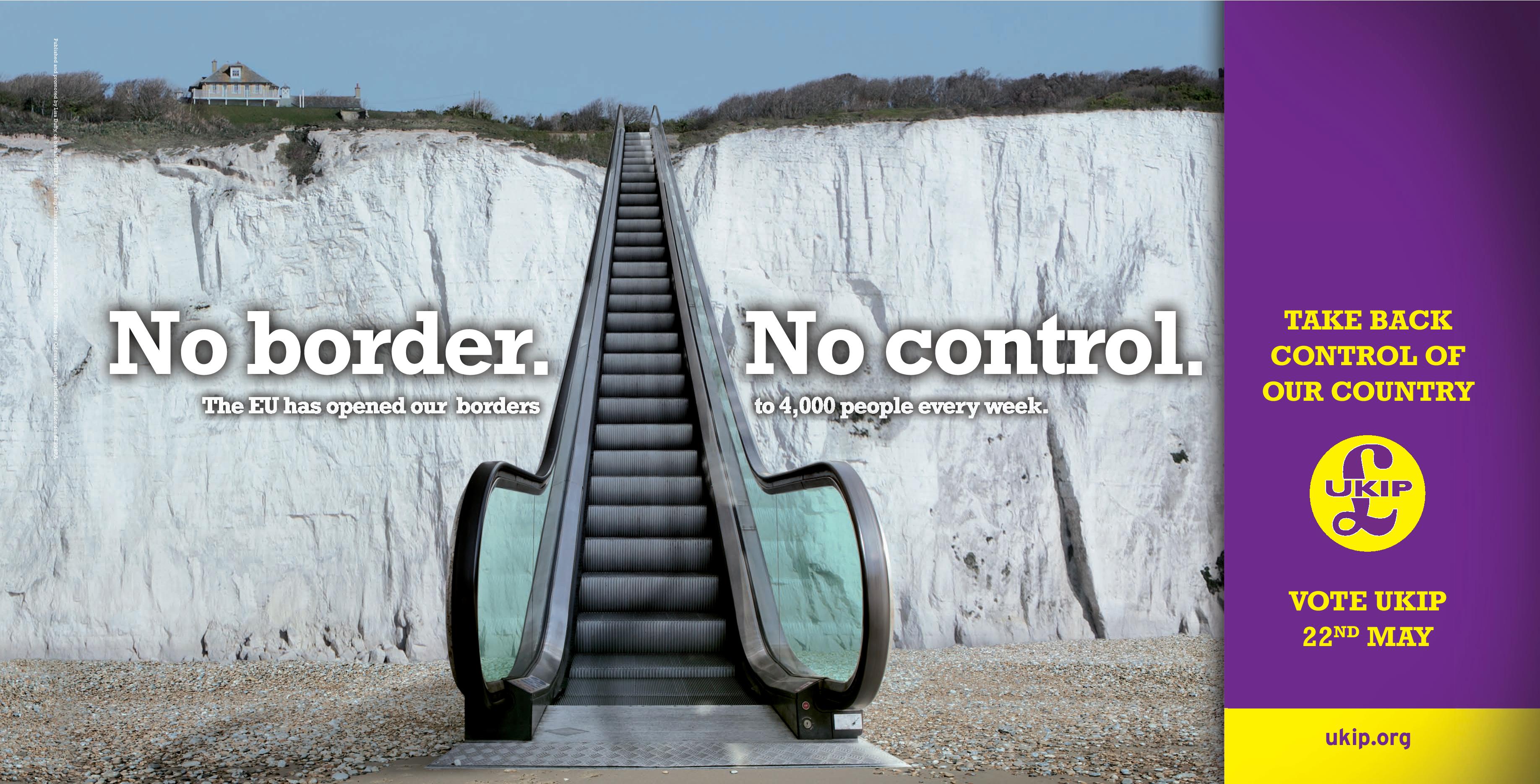
A poster published by the UK Independence Party for the 2015 election. Led by Nigel Farage, the populist, English nationalist movement thrived on the resentment fueled by the EU enlargement of 2004 and the subsequent immigration from Eastern Europe.The outcome was the vote for Brexit in 2016. Today, Farage leads a new political party, Reform UK, with the same demagogy.
June 2016 : the vote for Brexit
- In June 2016, the referendum led to the victory of the “leave”. David Cameron, who had supported the “remain”, had to resign. He was succeeded by Theresa May who could not convince the MPs to accept the deal she had negotiated with the EU.
- So Britain is still in a dead end. Brexit has not been implemented yet, but the situation in the UK raises much concern: Scotland, which had voted for the “remain”, does not want to get out of the EU against her will. In Northern Ireland, Brexit would transform the border into a hard border. This raises the prospect of a new civil war in Ulster.
- The UK officially left the EU on 31 January 2020.
28 May 2026
➪ Corrigé du sujet de devoir donné le 21 mai.