Part Four. Tensions and cooperations in North America.
April 3, 2026
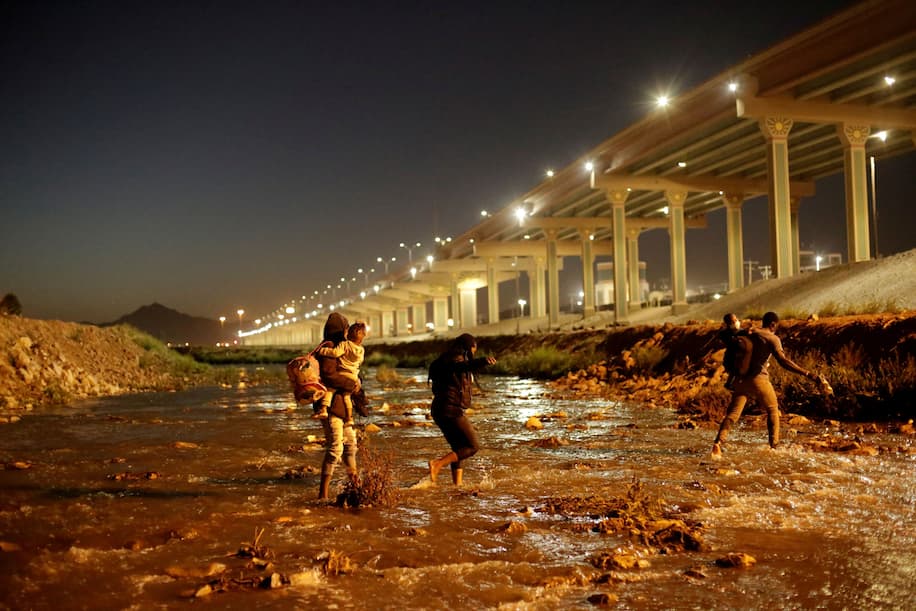
A family of migrants crossing the US-Mexico border.
Part Four. Tensions and cooperations in North America.
April 4, 2025
Ce thème sera exclu du programme de l'épreuve finale, du fait des nombreuses heures supprimées au 3e trimestre.
1 | What is North America ?
➣ In this chapter, we shall discuss the dialectics of tensions and cooperations between the three North American states. Although cooperation is obviously in the interest of each state, cultural and political differences create tensions. Another source of concern is the imbalance of power and the resulting US imperialism at the expense of Canada and Mexico, but also of other countries and territories of the North American hemisphere like Panama or Greenland.
❑ North America includes Canada, the USA and Mexico, but also the Caribbean (the West Indies)… and Greenland, a Danish overseas territory, part of the EU, but part of the “Western hemisphere” (WH). The WH is the American sphere of influence.
❑ The USA is, by far, the main power in North America. While Germany amounts to a little more than 25% of the EU’s GDP, the USA has got the lion’s share in the North American free trade zone with Canada and Mexico : 86%. The imbalance of power between the US and its neighbours is huge.
❑ Beginning in 1994, a free trade zone, the North American Free Trade Agreement (NAFTA) was established. It is a common market, like the EU. But contrary to the EU, it is not a political project. In the European Union, a citizenship was established through the treaty of Maastricht which, in 1991, created the EU. In North America, there is no common citizenship. It was never planned. In 2021, NAFTA was succeeded by the USMCA (a change decided by President Trump during his 1st term).
The relationship between the US and Canada
➪ SUBJECT №1 : Tensions between the USA and Canada (annotated)